-
Process Safety Information (PSI):
- Chemical Data Properties and hazards
(toxicity, reactivity, flammability).
- Process Technology Flow diagrams, operating
limits, and control schemes.
- Process Equipment Information Specifications,
materials of construction, and safety systems.
-
Operating Procedures:
- Develop clear and detailed standard operating procedures (SOPs)
for handling hazardous processes.
- Ensure these procedures cover normal operations, startup, shutdown,
emergency operations, and temporary operations.
-
Process Hazard Analysis (PHA):
- Conduct systematic reviews of processes
to identify potential hazards.
- Use techniques like HAZOP (Hazard and Operability Study)
and FMEA (Failure Mode and Effects Analysis).
- Ensure PHAs are updated regularly,
especially after modifications.
-
Management of Change (MOC):
- Implement a formal MOC process to evaluate the safety impact of any process
or operational change.
- Ensure all changes are reviewed, approved, and documented before implementation.
-
Pre-startup Safety Reviews (PSSR):
- Conduct safety reviews before the startup of new or modified processes.
- Ensure all safety, design, and operational standards are met.
-
Mechanical Integrity:
- Ensure all equipment related to hazardous processes
is properly maintained, tested, and inspected regularly.
- This includes valves, tanks, vessels, piping systems,
emergency shutdown systems, and safety devices.
-
Training:
- Provide thorough training to all employees on PSM,
process operations, and emergency procedures.
- Offer refresher courses regularly to ensure
employees are up-to-date on safety practices.
-
Employee Involvement:
- Engage employees at all levels in safety management activities.
- Form safety committees, conduct safety reviews,
and ensure transparent communication.
-
Contractor Management:
- Ensure contractors are trained and knowledgeable about the site's safety requirements.
- Monitor contractor performance to ensure adherence to safety protocols.
-
Emergency Response Planning:
- Develop and implement emergency response plans in case of accidental
releases or other safety incidents.
- Train employees on how to respond during emergencies and coordinate
with local emergency response teams.
-
Incident Investigation:
- Investigate all incidents, including near-misses, to determine root
causes and prevent future occurrences.
- Implement corrective actions based on findings from the investigation.
-
Compliance Audits:
- Conduct regular audits to ensure compliance with PSM regulations and
internal safety standards.
- Use audits to identify gaps or areas for improvement in the PSM program.
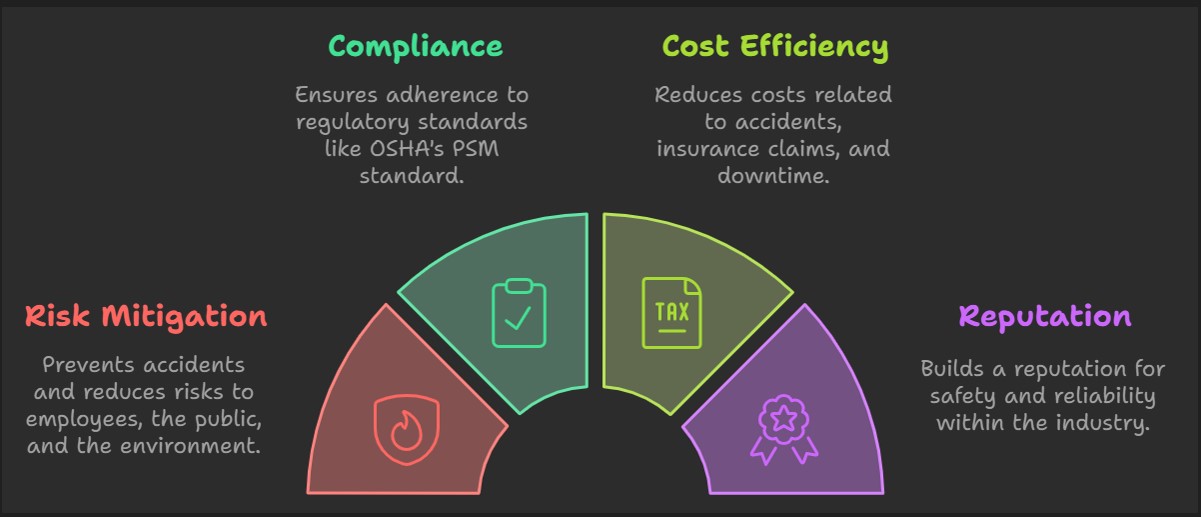
PSM is crucial for industries dealing with hazardous
processes to maintain safety and operational efficiency.